How KeyProof protects the record.
What is in place today, and what we do not claim.
- Each firm sees only its own hires.A request for another firm's hire is refused and logged.
- ID images stay with Stripe.KeyProof keeps only the result of the check.
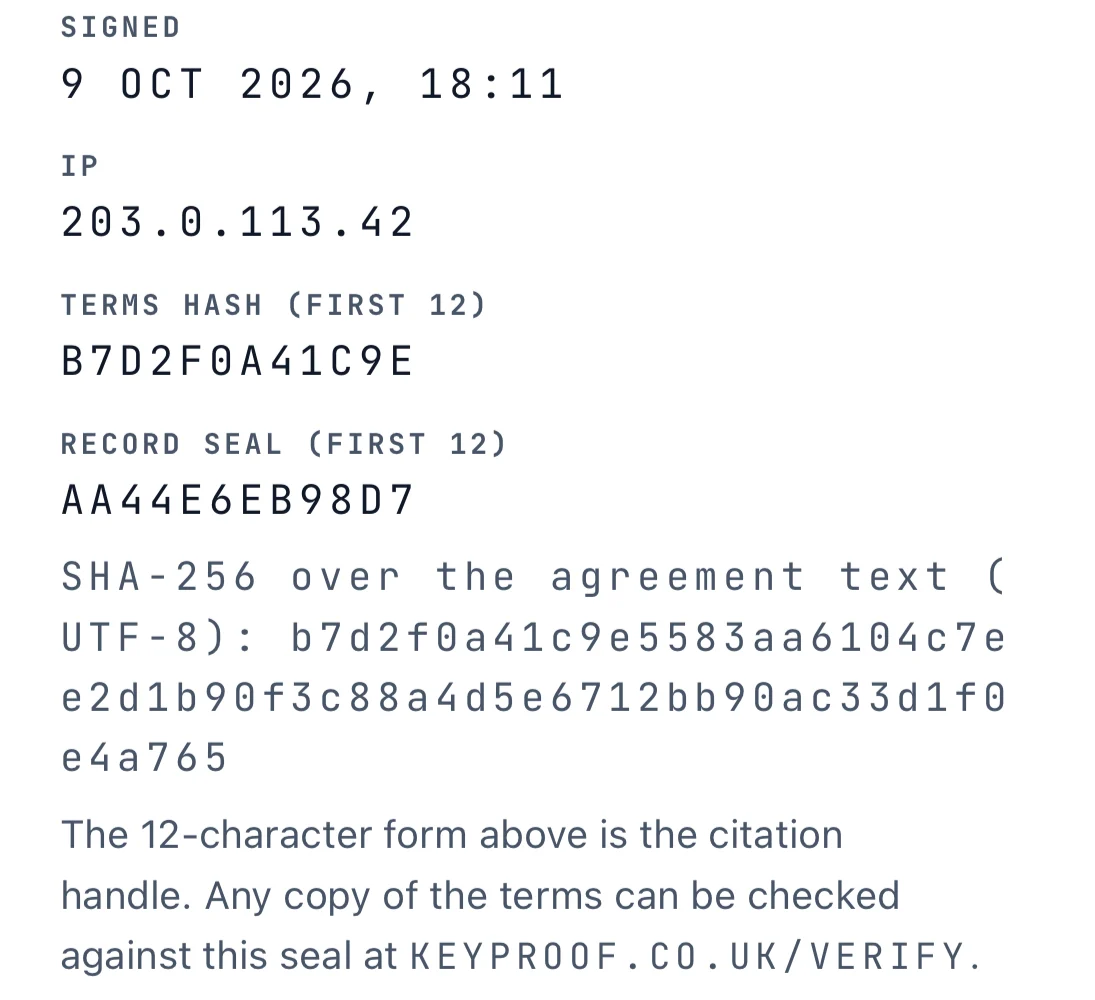
- Every sealed record carries a SHA-256 fingerprint.Anyone can check it, with no account.
Check it yourself.
Every line here can be checked without asking us.
Hold less.
Checking a hirer usually leaves a firm with a folder of passport and licence photos to protect. KeyProof keeps the result of each check, not the documents behind it.
- Identity
- Photo ID and a matching selfie are checked by Stripe Identity. KeyProof keeps the outcome and a reference, never the images.
- Licence
- The hirer supplies a DVLA share code and the firm checks it on GOV.UK. KeyProof never contacts the DVLA and never sees the driving record.
- Handover selfie
- A firm can view the hirer’s verified selfie at handover, fetched live from Stripe and never stored, only where the hirer consented to that view, and every view is logged. It stays switched off until its own data protection assessment is co-signed by both founders.
- Retention
- Share codes are erased 30 days after signing. A hire record is deleted 24 months after the hire ends, unless an open dispute, claim or fine holds it.
Each firm sees only its own hires.
The firm is the controller of its hirers’ data. KeyProof processes it on the firm’s instructions, under an agreement that meets Article 28 of the UK GDPR, set out in the privacy notice.
- Tenant separation
- Every query is pinned to the signed-in person’s firm. A request for another firm’s hire is refused and recorded as a security event. An address that matches two firms gets neither.
- Tested every release
- Isolation tests seed two firms in a real database and call the real routes as each. They run on every release, and a release cannot deploy without them.
- Roles
- Owner-only actions work only for the firm’s owner. Staff get nothing back.
- Founder access
- Deny by default: an empty allowlist admits nobody.
A change to the record shows.
The agreement is fingerprinted with SHA‑256 at the moment the hirer signs, and anyone holding the record can check its seal without an account. Tamper-evident, never tamper-proof.
- Condition photos
- Stored privately, never as public links, and served only after the request has been checked.
- In transit and at rest
- HTTPS only. The product database sits on Neon, and photographs and documents on Vercel; both encrypt data at rest on their own infrastructure. Every provider is named on the sub-processor list.
- Off-site copies
- Database exports and the second copy of each condition photo are encrypted by KeyProof with AES-256-GCM before they leave our systems for Cloudflare R2.
- Payments
- Every Stripe event’s signature is verified, and an event already handled is never run twice.
One way to production.
Pushing code does not release it. The hosting provider’s own deploy trigger is switched off, so the pipeline is the only route.
- The pipeline
- Type checks, the full test suite against a real database, the schema, and only then the deploy. If the suite fails, nothing deploys.
- Public forms
- Rate limited. If the shared limit store cannot be reached, the protected forms refuse rather than run without a limit.
- Health check
- Answers healthy or not, and gives away no job names or error text.
Insured.
KeyProof Ltd holds professional indemnity and cyber and data cover with Hiscox, in force from 30 July 2026. It is the company’s own cover, not a policy that insures hire firms or hirers.
- Professional indemnity
- £1mwith Hiscox
- Cyber and data
- £500kwith Hiscox
What we do not claim.
So you can hold every other line on this page to the same standard.
- Certification
- KeyProof holds no SOC 2, ISO 27001 or Cyber Essentials certificate, and has not had an independent audit or penetration test.
- Registration
- Registering with the ICO is a legal duty met, not an approval. Nobody has certified KeyProof, and this page does not suggest otherwise.
- Isolation
- Firms are kept apart in application code and its tests, not by database row-level policies.
Found a security problem?
Email security@keyproof.co.uk with enough detail to reproduce it. We read every report, we will not take legal action against good-faith research, and we ask for a reasonable window to fix the issue before you publish.
Data-protection questions go to privacy@keyproof.co.uk. Your rights, and how to use them, are in the privacy notice.