It starts with proof.
Then it runs everything around it.
One link, sent in the chat you booked them in: they prove who they are, hand you a DVLA share code to check, sign your agreement and put up the deposit, and the car is photographed at both ends. You end up with one record: dated, sealed, and ready to hand an insurer.
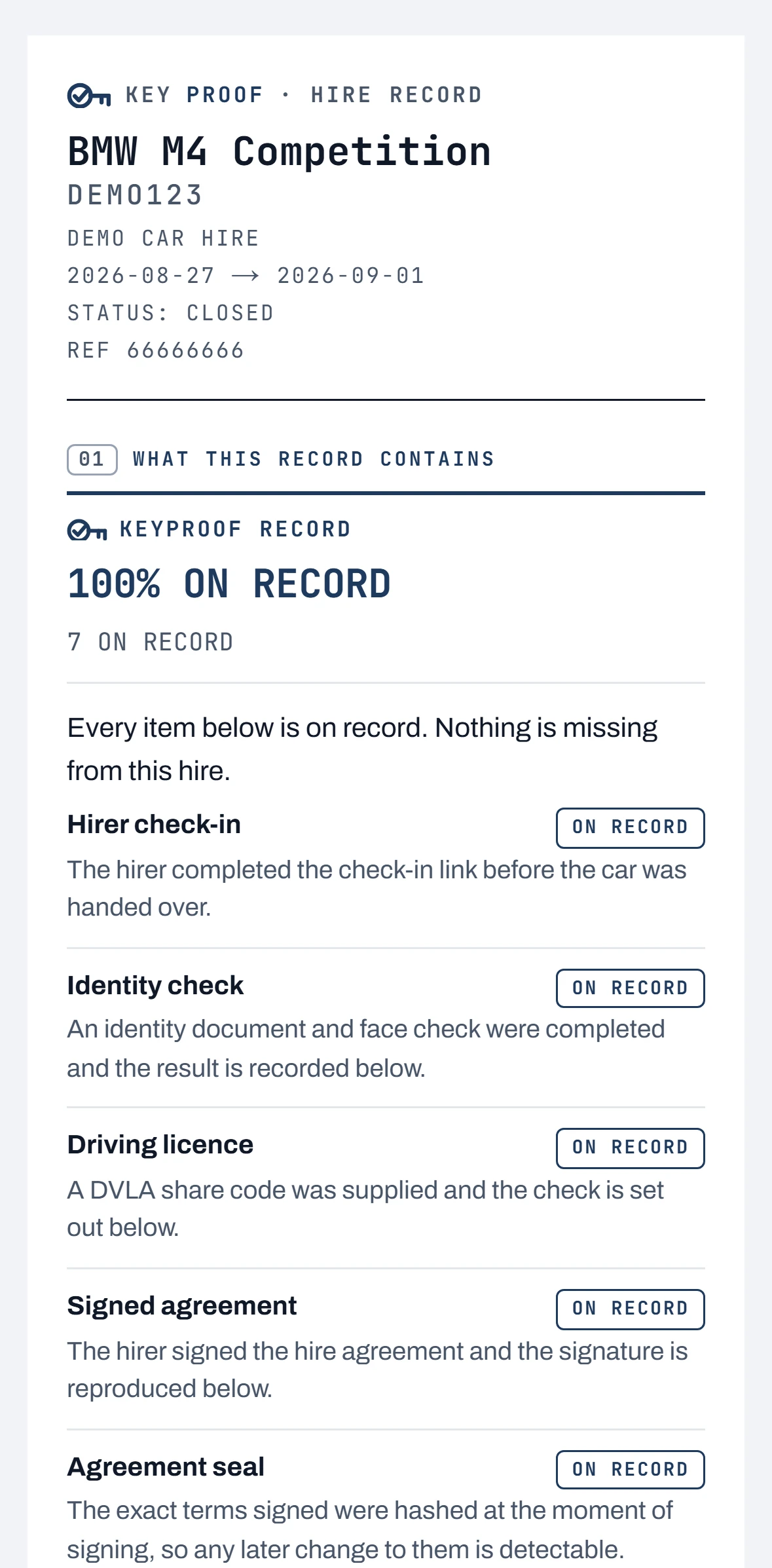
Illustrative record. Not a real hirer.
Management, compliance and proof, in one system.
Management is the part you open every morning. Compliance is what has to be true before the keys move. Proof is the record you reach for the day a hire goes wrong. KeyProof is all three, running under the way you already take bookings.
What you open every morning.
- Bookings
- Fleet
- Money
- Maintenance
Settled before the keys move.
- Identity
- Licence
- Agreements
- Deposits
- Data protection
The record you reach for when a hire goes wrong.
- Handover
- Return
- Timeline
- Sealed record
- Insurer share
- Hash verification
It’s just a link you send your client.
No new app to learn, no account for your customer to make. You drop a link into the chat you’re already in, they tap it, and you’re covered.
At handover, you send the link
In the same Instagram or WhatsApp chat you booked them in, you drop the KeyProof link. Nothing new to open, nothing to explain.
On their phone, they check themselves in
They tap the link and it opens in their browser. Name, date of birth and home address; a DVLA share code and the last 8 characters of their licence number, because gov.uk wants both before it will show you anything; then the identity check, where they photograph their ID and take a live selfie and Stripe, the regulated provider, matches the two and holds the images. You see the result, never their documents. Then a signature on your agreement and the deposit, held on your own Stripe. No app, no account, no password.
BMW M4 Competition · secure check-in
In your record, ready when you need it
It all lands in one record on your side: who they were, that they were cleared to drive, and exactly how the car looked. If a hirer disputes the damage or drives off, you hand it to your insurer.
That is it beside this, on a made-up hire. It opens by stating what it holds and what it does not, each check marked on record or not, so a thin record cannot pass as a full one. More on the record.
This is the actual app.
Not an artist’s impression.
Two screens on a made-up firm called Demo Car Hire: the morning queue, and one protected hire opened in full. Each one is photographed from the app itself, the same components a paying firm gets, working the same numbers out the same way. Only the hires are invented.
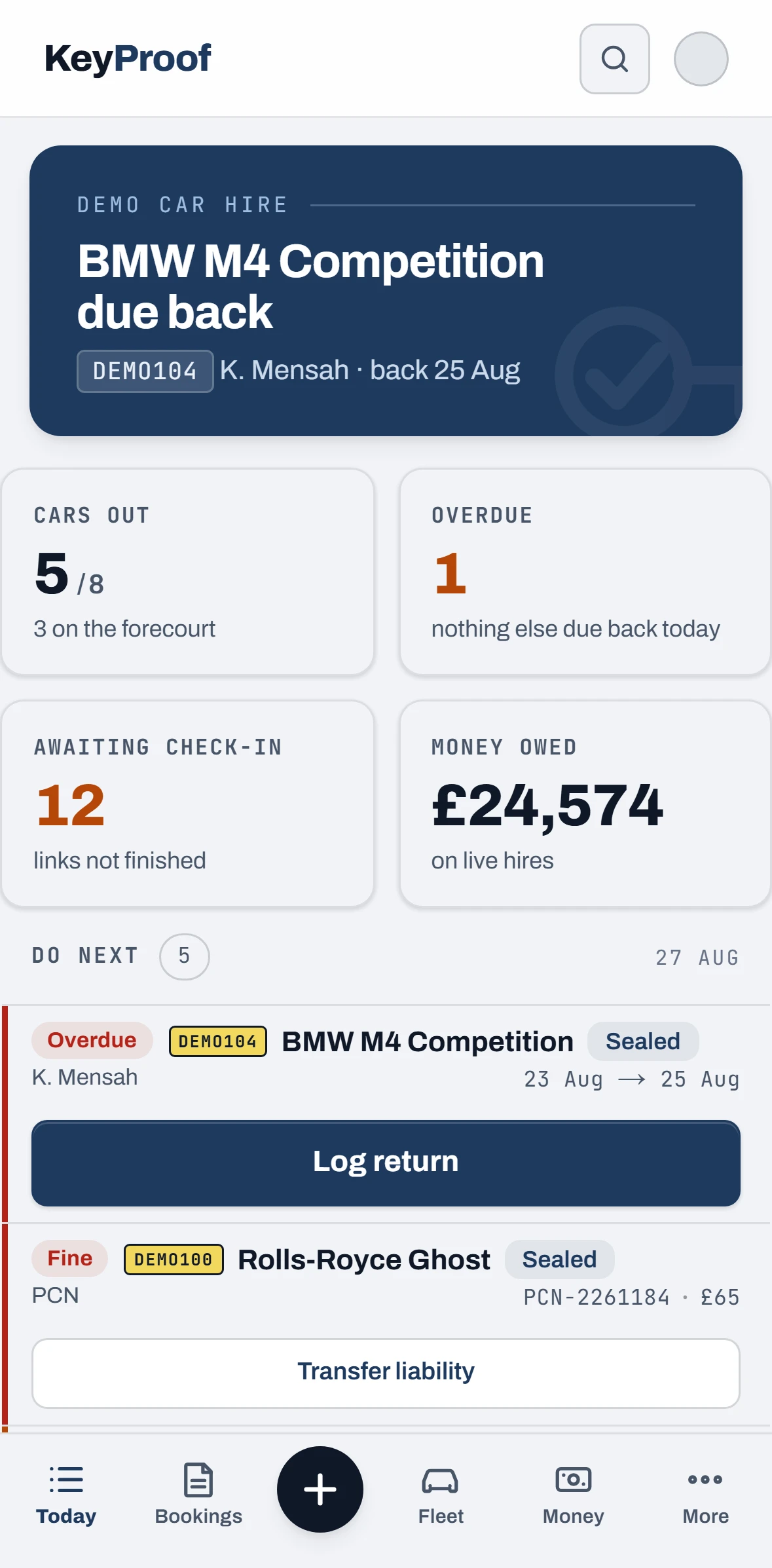
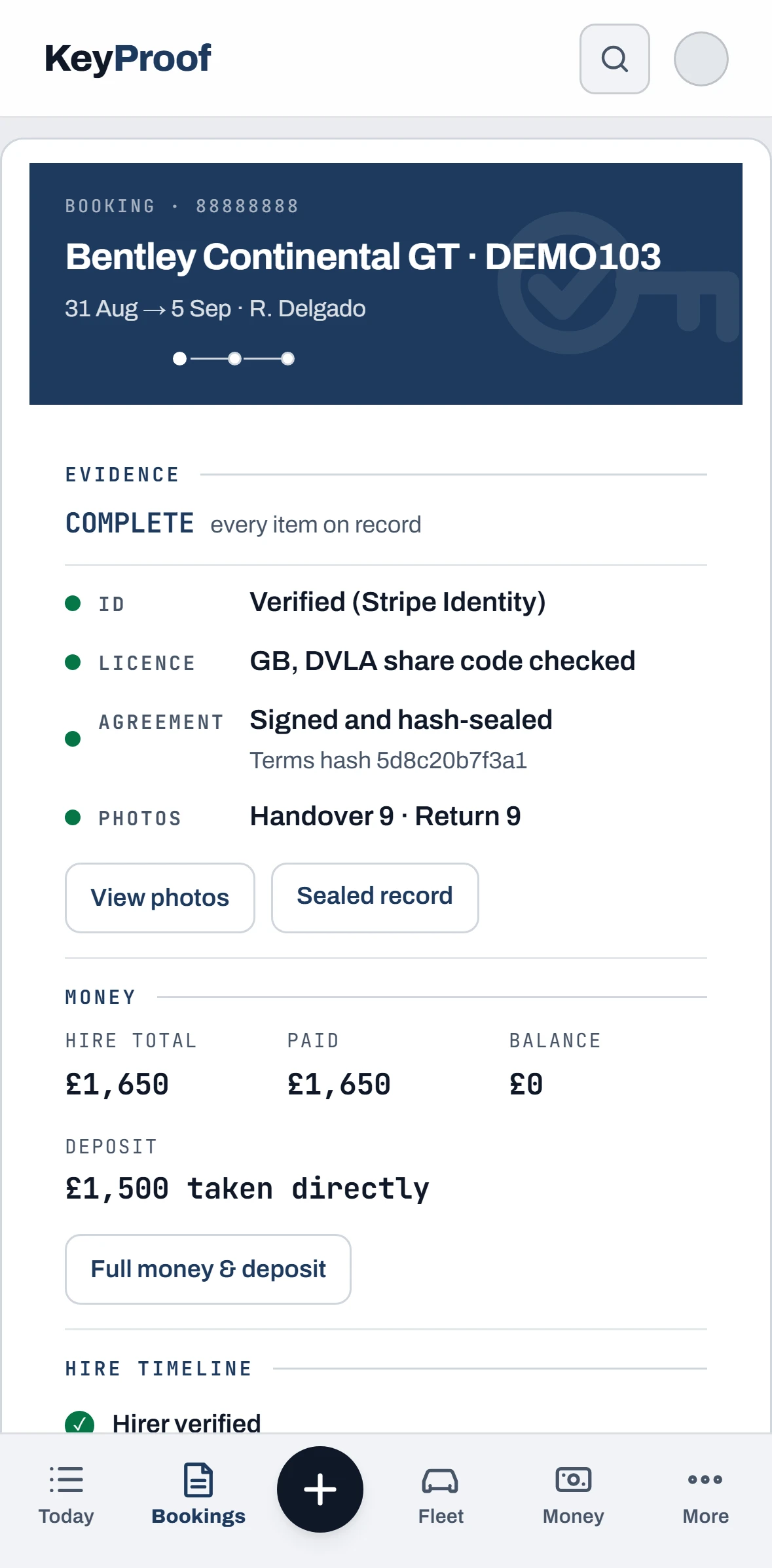
The same app on a laptop.
Rooms across the top, the day's numbers down the left, the work in the middle: the layout a firm gets on the counter machine. Same components, same made-up firm as the phones above.
- One queue of what needs your hands now
- Sealed records marked on the hires that carry them
- A seven-day window with double bookings flagged
- MOT, insurance and service dates tracked per car
- Money owed, and how much of it is past due
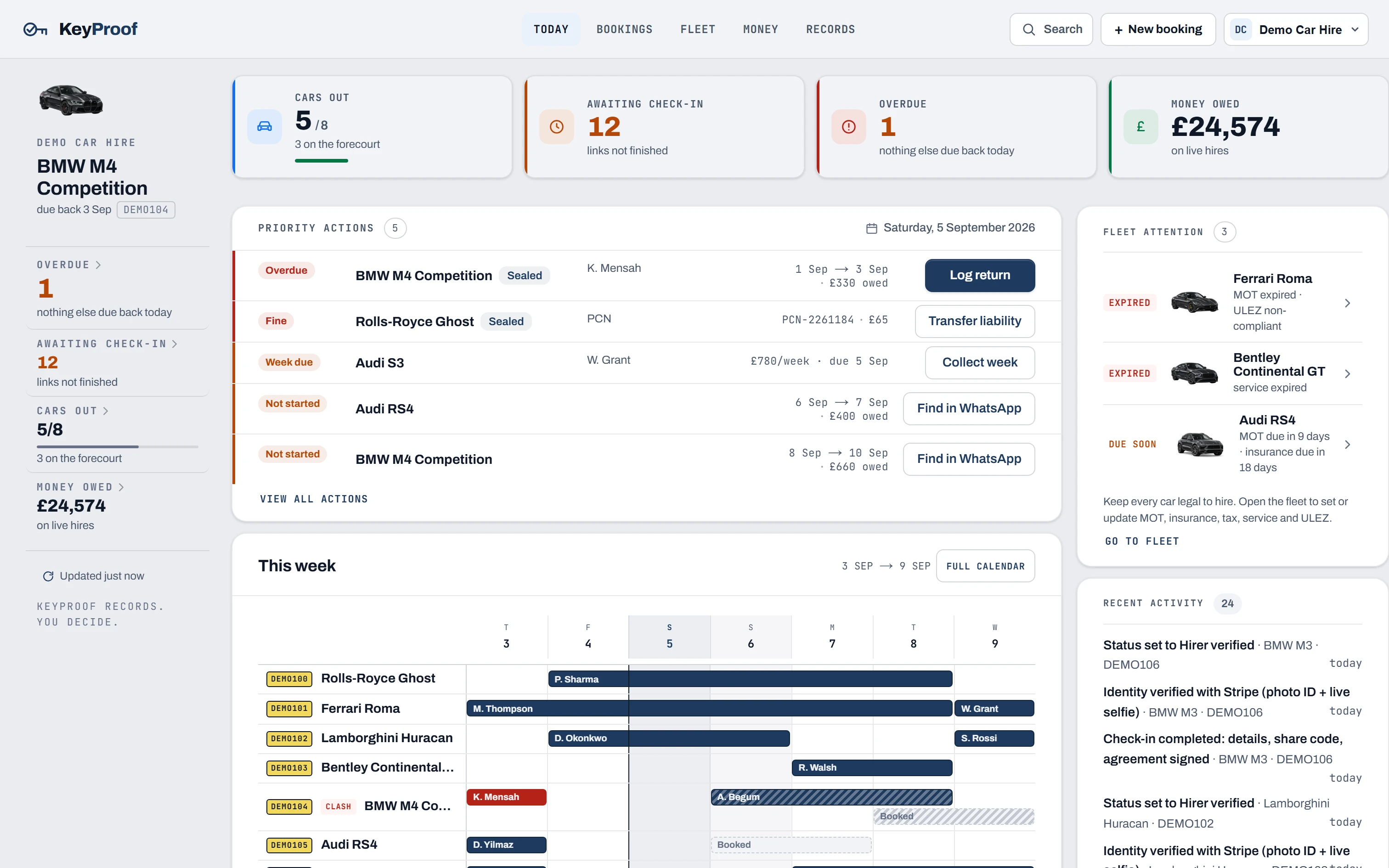
Sample data. Demo Car Hire is not a customer: no firm has signed KeyProof yet, and nothing above is a real hire, hirer or vehicle. Rather drive it than look at it? Run the hirer check-in.
Never double-book a car, never miss a renewal, know what earns.
The diary, the fleet and the figures, on the same subscription as the proof. An expired MOT is a car off the road and can give an insurer grounds to dispute a claim, so the paperwork sits in one register with a warning before anything runs out.
Never double-book a car
Every vehicle has its own live calendar: what is out, what is due back, what is free. Try to book a car that is already out and KeyProof stops the booking until you confirm the clash, and writes the override to the hire's timeline.
Never miss a renewal
MOT read from the DVSA record, with insurance, service and ULEZ per vehicle. KeyProof warns you before an insurance or service renewal falls due, instead of leaving you to remember.
Know what actually earns
Rates, invoices, deposits, fuel and running costs all land on the car they belong to, totalled into profit per car and days out on hire. The car that looks busy but loses money stops hiding.
Per-booking reminders go out automatically in your firm’s name, with one-tap unsubscribe on every one. A hirer you have had before is recognised from your own past bookings and their details prefill.
Every named driver logged against the hire, not just the person who paid, so the record matches who was allowed behind the wheel.
Service history against the car it belongs to, with the V5, insurance schedule, MOT certificate and warranties held beside it.
Once the return is logged, the same link asks the hirer to rate the hire, with a nudge to copy a good one to Google. Ready-made WhatsApp templates cover the messages you send yourself.
KeyProof is not a payment processor and never holds a penny of yours. Take the money the way you already do: cash, bank transfer, your own card machine, or a deposit held on your own Stripe account, in your name, settling to your bank. What we keep is the record: that the deposit was taken, what was owed, and what was settled. Weeks later, when a hire is disputed, that record is what you have left.
The proof at the core, and the risk handled around it.
Every hire ends in one record, and the printed pack opens by stating what is on it and what is not. The rest of the risk work hangs off that same record, so a dispute is rarely just your word against theirs. You decide what counts as new damage, every time: KeyProof records the before and the after and never scores them.
A record that states its own gaps
You saw the register above. A record with no licence check looks, at a glance, exactly like one with a licence check, because a missing section is simply not there. If a thin record can pass as a complete one, every complete record the product issues is worth less. So it says so instead, in the same place every time, off the booking’s own columns rather than a flag anyone can set. This is the condition record everything else is built on, and what a full record holds.
Sealed at signing, sendable without a login
The exact wording your hirer signed is snapshotted and hashed with SHA-256 the moment they sign it, every condition photo gets its own fingerprint, and the hire itself is sealed over the lot, which makes the record tamper-evident: any later change is detectable by anyone holding it. When an insurer wants the file, one tap mints a read-only link to that one hire, no account and no login, expiring after 7 days, with the DVLA share code and the hirer’s contact details withheld. Minting it is stamped on the booking’s own timeline, so sharing is part of the chain of custody, and you can revoke every live link at once.
Fines and PCNs, packaged for liability
A penalty lands weeks after the hire, and the record already knows who had the car: their name, date of birth, address, licence and the agreement they signed. Each ticket is logged against that exact booking with its reference, the issuing authority, the date of the contravention and the day it has to be answered by, so an open fine is never missed before its deadline. That signed agreement and those hirer details are what the authority needs to redirect the penalty to the driver, so you recharge the hirer or transfer liability to the council from the record itself, and track every ticket from logged through to recovered.
Insurance claims logged to the booking
When a claim opens, it sits against the hire it came from, with the proof pack attached, so you are never reassembling evidence from a drawer and a camera roll under a deadline.
A private blocklist that stays yours
A hirer who caused trouble goes on your own private blocklist, so they cannot quietly book again. It is your list, kept to your firm, never shared or sold.
Nothing deletes in the middle of an argument
Hirer data comes off the system on a schedule, with one exception built in. While a dispute is flagged, a claim is open or a fine is unresolved, that record is held back from the sweep and a delete against it is refused, with the reason given. The hold is read live off those three states, so it lifts by itself the moment the matter closes.
Your chat stays your chat. Everything behind it lands here.
KeyProof does not replace how you sell. Keep taking bookings on Instagram and WhatsApp, keep your own agreement, keep your own deposit. What changes is that the diary, the fleet, the money and the proof stop living in your head and start living in one place you can hand to an insurer, a staff member or your accountant. When something goes wrong, nobody searches a chat, a camera roll and a bank statement: they open the hire record.
- A paper diary
- A spreadsheet
- The camera roll
- An email inbox
- The diaryBookings and a clash-guarded calendar
- The fleetMOT, insurance, service and the documents
- The moneyRates, deposits, invoices and profit per car
- The proofThe sealed record every hire ends in
The demo runs the real hirer screens rather than a mock-up, so you can judge this product without a customer list. Which is just as well: KeyProof is pre-launch and no hire firm has signed yet. It is being built for a founding cohort of UK firms. Try it in the demo, see what it costs, or how it sits against rental management software.
Proof at the core.
The whole firm around it.
One flat price runs the bookings, the fleet, the money and the proof.
Locked for life, any fleet size.
30 days free on every plan. No setup fee, no contract, cancel any time.