They started from the calendar. KeyProof started from the proof.
KeyProof now runs the diary too: the calendar, the clash warnings, the customer records, the money. The difference is where each tool began, and that shows the day a hire goes wrong. Here is the honest version, from a company that built proof first.
Private beta applications open, public launch January 2027The hirer pays their own £4.99 verification feeSet up with you by a founder
No firm has signed yet. KeyProof is choosing up to five UK hire firms for its private beta, set up and walked through their first real hire by a founder: request beta access.
KeyProof Ltd 17333773ICO ZC195906Own PI £1m + cyber £500k, Hiscox
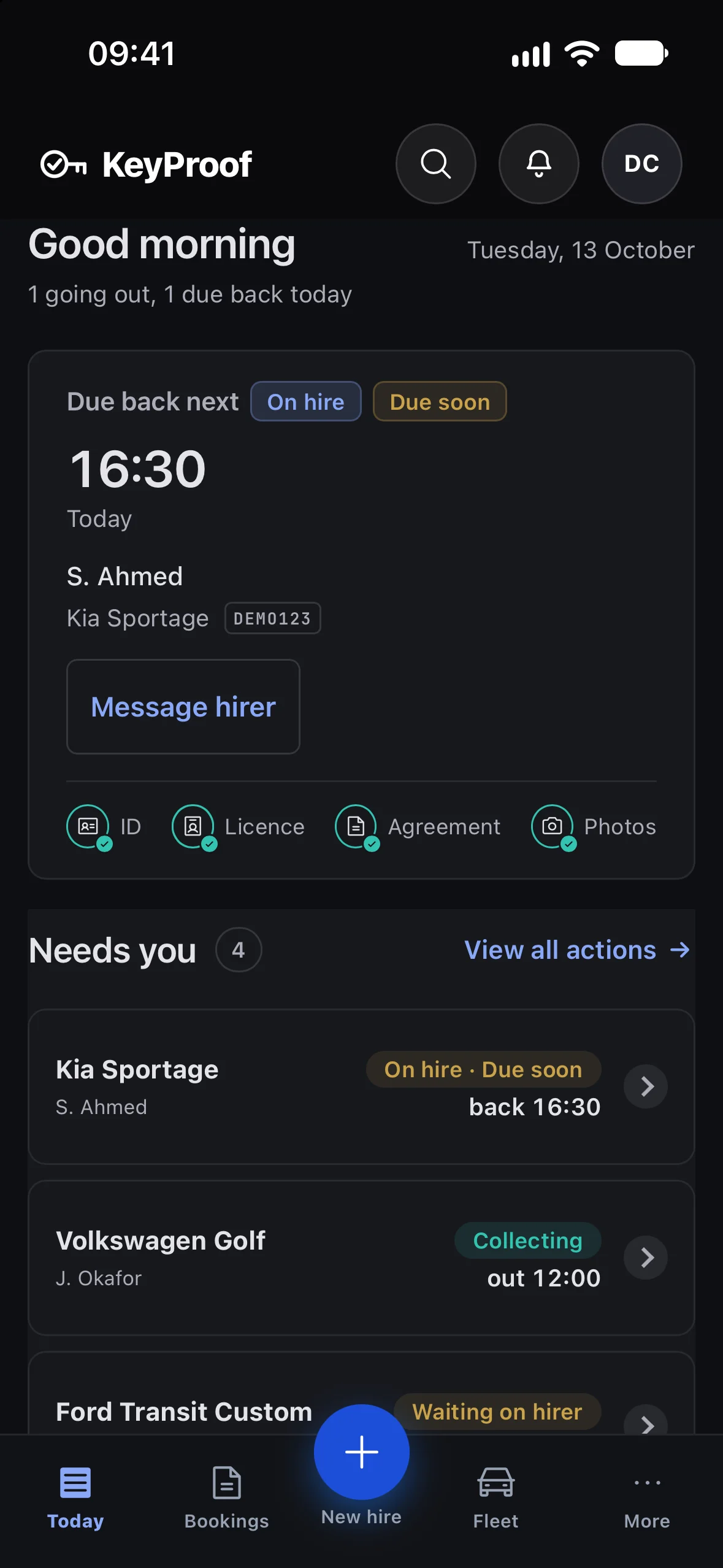
Same diary. Different foundation.
- Rental platforms grew from the calendar
- They began as booking systems: diaries, availability, invoicing, a customer-facing website. Proof got bolted on later, if at all. The handover, the part that decides every dispute, was never the point.
- KeyProof grew from the evidence
- It began at the handover: verified identity, a DVLA share code for you to check, your agreement e-signed, condition photos, one record you can hand your insurer. The calendar, clash warnings, customer records and money tracking grew around that core.
- Scanning a licence is not checking a licence
- This is the difference most worth understanding, because the words sound identical. Document scanning reads what is printed on the card, which is useful for filling a form in seconds but does not confirm the licence is genuine or current. A DVLA check is a different act: the firm checks the share code on gov.uk and the answer comes back from the DVLA, confirming the licence exists, is current, and what is on it. One saves typing. The other is the thing you rely on when a hire goes wrong.
- Platforms assume you want to change how you sell
- Moving to a booking platform means moving your customers to it. If your bookings genuinely live in Instagram DMs and WhatsApp, and that is working, migrating them to a website funnel is solving a problem you do not have.
- When a hire goes wrong, the foundation is what matters
- A calendar with paperwork bolted on gives you a booking history. A system built on proof gives you a record that settles the dispute instead. KeyProof runs the diary on top of it, on a flat monthly plan banded by fleet size, which a small fleet can justify.
Same diary, different foundation. Side by side.
| Capability | KeyProof | Rental platforms |
|---|---|---|
| Booking calendar and diary | Yes, KeyProof runs the diary too. | Yes, this is where they began. |
| Started from proof of the handover | Yes, the evidence was the point. | No, proof got bolted on later, if at all. |
| Migrating your customers to a booking website | None. Keep your DMs. | Usually yes. |
| Verified ID, a DVLA share code, e-signed agreement and timestamped photos in one record | The foundation. | Varies, added on top of the calendar. |
| How the licence is actually checked | A DVLA share code the firm checks on gov.uk. The answer comes from the DVLA. | Commonly document scanning, which reads the card it is shown. |
| Runs from an Instagram or WhatsApp DM | Yes. | Platform-first. |
| What settles a dispute the day a hire goes wrong | A record built on proof. | A booking history. |
| Terms hashed at the moment of signing | SHA-256 over the exact wording, so any later change is detectable. | Varies. Often the agreement is stored, not sealed. |
| Sending one hire to an insurer without a login | A read-only link that expires after 30 days, with the share code and hirer contact withheld. | Usually an export, or an account for them. |
| What happens when the hirer will not verify | You hand over anyway, type a reason, and the record says on its face that no check-in happened. | Not a case most booking systems model. |
| What the record says about its own gaps | Names every missing item in the same fixed place, off the booking’s own columns. | A blank field reads the same as a completed one. |
Not a claim that rental software is worse. Sometimes a firm needs both, sometimes neither. It is a different foundation for a different firm.
So which do you actually need? Sometimes both. Sometimes neither.
If you run twenty-plus cars with staff, a public booking website and channel management across brokers, a dedicated rental platform may still earn its keep, and KeyProof closes the evidence gap it leaves at the kerb. If you run a handful of cars through DMs, KeyProof now covers both sides: the bookings and the proof, without moving your customers anywhere. And if you never have disputes, never worry about who is driving, and your insurer loves you, honestly, you may need neither. KeyProof's private beta opens in November, being built with a founding cohort of UK hire firms rather than by one: how it works, the FAQ (including this exact question), and the demo.
What every hire leaves behind
IdentityPhoto ID matched to a selfie
LicenceDVLA share code, for your own check on gov.uk
ConditionTimestamped photos, both ends
AgreementE-signed, sealed with a hash
DepositLogged, traceable to the hirer
Keep your booking chat.
Run it on proof.
Nothing about how you take bookings has to change. The proof goes underneath it.
KeyProof is selecting UK car hire operators for its private beta, ahead of public launch in January 2027.